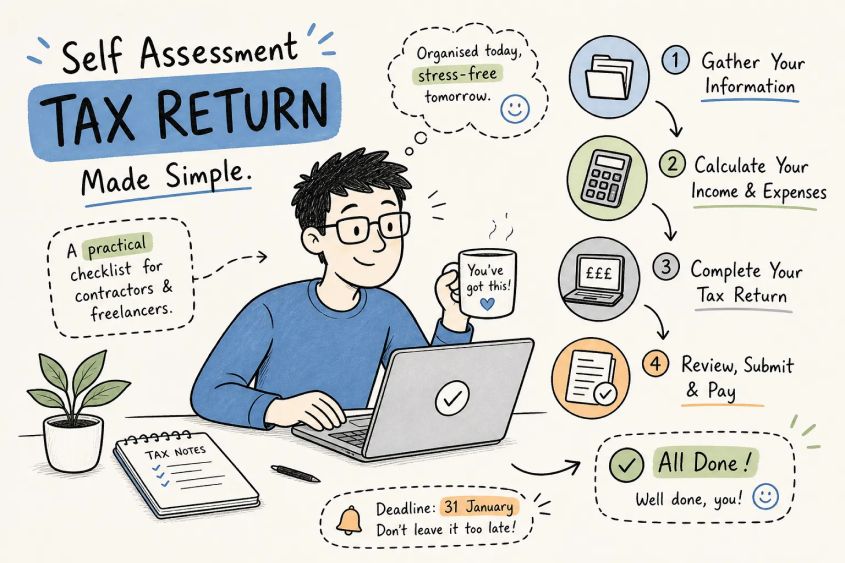
The deadline crept up again. You meant to sort the paperwork in November, then December, then after Christmas. Now it is mid-January, the pile of receipts looks three months deep, and what felt like a straightforward task has somehow become a source of genuine dread. If that sounds familiar, you are in very good company. At Sylwia Klocek Accounting Ltd, we work with many contractors, freelancers, landlords and limited company directors on their self assessment tax return each year, and the same obstacles come up repeatedly: records that were never quite gathered, deadlines that were slightly misunderstood, and expenses left unclaimed simply because nobody told the client they were entitled to them.
The good news is that completing your self assessment tax return with HMRC is entirely manageable once you understand the structure. There is a logical sequence to it, the records you need are predictable, and the rules around allowable expenses are more straightforward than most people assume, particularly once you know where to look in HMRC's published guidance. This article walks through the whole process, from checking whether you need to file at all, through registration and record-gathering, right up to submission and payment. By the end, you will have a practical checklist you can act on straight away.
Who actually needs to complete a self assessment tax return
Not everyone in the UK needs to file. If your only income comes from employment and your tax is correctly collected through PAYE, a return is usually not required. The obligation kicks in when your circumstances include income or gains that PAYE has not fully captured.
Sole traders with gross self-employed income above £1,000 must file, as must anyone in a business partnership. Contractors operating through a limited company typically receive a combination of salary and dividends, and company directors are almost always required to file a personal Self Assessment return, even when their tax affairs seem simple on the surface. The salary element may be collected through PAYE, but dividends are not, and that alone triggers the obligation.
Several other situations require a return. Landlords receiving rental income from UK or overseas property must report it, regardless of how modest the amounts seem. If your total taxable income reaches £150,000 or more, a return is required even if tax has been deducted at source. Other common triggers include capital gains from selling shares or property, savings interest that reaches HMRC's reporting threshold or means tax is due (note that interest from ISAs is excluded), foreign income of any kind, and the High Income Child Benefit Charge. HMRC can also formally issue a notice requiring you to file, at which point submission becomes mandatory unless HMRC cancels the requirement in writing.
How to register and get your UTR number
If you have never filed before, registration is the first step, and it needs to happen well before you sit down to complete the return itself. For the 2025, 26 tax year, first-time filers must register by 5 October 2026. Missing this date can result in a penalty before you have even started.
The process runs through the Government Gateway or GOV.UK One Login. Create an account if you do not already have one, then use HMRC's "Check how to register for Self Assessment" service. You select the reason you need to file, such as self-employment, rental income or other untaxed income, and submit your registration alongside your National Insurance number. HMRC then issues a Unique Taxpayer Reference, a 10-digit number known as your UTR. Under HMRC's current online service, a UTR can appear in your account within 72 hours, though postal confirmation may take longer.
Your UTR is essential: you need it to file your Self Assessment return and to use any approved tax software. One point worth flagging is that people who registered previously but skipped a year do not always need to register again. They may simply need to reactivate their Self Assessment account, which is a different process. Attempting to register fresh when an account already exists causes unnecessary confusion and delays.
Deadlines and what HMRC charges when you miss them
The deadlines for the 2025, 26 tax year are fixed. Paper returns must be submitted by 31 October 2026. Online returns, along with any tax owed, are both due by 31 January 2027. A second payment on account, where applicable, falls on 31 July 2027. There is also a lesser-known deadline of 30 December 2026 for anyone who wants HMRC to collect underpaid tax through their PAYE tax code rather than paying directly.
The penalties for missing these dates stack up faster than most people expect. A £100 fixed penalty applies the moment a return is late, even if no tax is owed and even if the return is only one day overdue. After three months, HMRC adds £10 per day for up to 90 days, bringing the daily-penalty total to as much as £900. After six months, a further charge of £300 or 5% of the tax due applies, whichever is greater. After twelve months, that same charge stacks on top again. For late payment specifically, HMRC levies 5% of the unpaid amount at 30 days, again at six months, and again at twelve months, plus daily interest currently running at 7.75% per year from the original payment deadline (effective from 9 January 2026, per HMRC's published rate).
If you have a genuine reason for missing a deadline, you can appeal on the grounds of a reasonable excuse, and HMRC does consider such cases on their merits, you can submit an appeal via your online HMRC account or in writing. The underlying tax and any interest, however, remain payable regardless of the outcome.
The records checklist: everything to gather before you open the SA100
The SA100 is HMRC's main self assessment form, but it does not handle every type of income directly. Most of the detailed figures go on supplementary pages, which then feed into the main return. Understanding which pages apply to you before you start saves a significant amount of time and prevents errors.
The supplementary pages cover distinct income types. A quick reference:
- SA102, employment or directorships
- SA103, sole-trader self-employment
- SA105, UK property income
- SA108, capital gains
- SA106, foreign income
The SA100 itself covers personal details, interest and dividends, pensions, tax reliefs and the overall declaration. Figures are not entered twice; the supplementary pages calculate their totals and those figures carry across.
For each income source, gather the corresponding paperwork before you open the return. Employment income requires your P60, payslips and P11D. Dividends require vouchers or company records. Rental income requires rent schedules, letting-agent statements and mortgage-interest certificates. Capital disposals need purchase and sale confirmations with transaction costs. Savings interest needs annual certificates from your bank or building society. Foreign income needs overseas statements with exchange-rate workings.
On the expense side, keep a clear record showing the date, supplier, description, business purpose and amount for every claim. HMRC requires you to retain all records for at least five years after the 31 January filing deadline, even though receipts are not usually submitted with the return itself.
Allowable expenses for contractors, freelancers and landlords
Contractors and freelancers
For self-employed contractors and freelancers, HMRC allows deductions for costs incurred wholly and exclusively for the purposes of the trade. In practice, that covers a broad range: business mileage at HMRC approved rates, office supplies, professional subscriptions, accountancy fees, public liability and professional indemnity insurance, software subscriptions, training directly related to your current trade, and a proportionate share of home-working costs calculated either through HMRC's flat-rate method or on an actual-costs basis.
The difference these deductions make is substantial. A freelance designer with £42,000 in gross profit who identifies £3,200 in allowable expenses reduces their taxable income to £38,800. At the basic rate, that represents a saving of £640 in tax. Contractors who have never had their expenses reviewed properly often find considerably more than that waiting to be claimed.
Landlords
Landlords work under a slightly different framework. Allowable deductions include letting agent fees, repairs and maintenance to the existing property, buildings insurance, accountancy fees, ground rent, service charges, and legal fees for short tenancy agreements. What catches many landlords off guard is the Finance Cost Restriction, which has been fully in effect since April 2020. Mortgage interest on residential property is no longer deductible directly from rental income. Instead, it provides a basic-rate tax credit of 20% of the qualifying finance costs, calculated after rental profits have been established. A higher-rate taxpayer who once received full relief at 40% now receives only 20%, which significantly changes the tax position on a leveraged property portfolio.
A further area where errors are common is the distinction between a repair and a capital improvement. Repairs to an existing asset are allowable deductions; capital improvements are capital expenditure and are not deductible as repairs. Some qualifying items of capital expenditure may attract capital allowances in limited circumstances, see HMRC's published guidance for details. Getting this distinction wrong can lead to overclaimed deductions or, equally, relief that is never taken at all.
Filing your self assessment tax return online, paying your bill and when to bring in a professional
Submitting your self assessment tax return through HMRC's online service follows a clear sequence. Sign in to your Government Gateway account, work through the relevant sections of the SA100 and any supplementary pages, review HMRC's automatic tax calculation, and submit. Once you have submitted, save both the confirmation reference and the tax calculation. These documents are your evidence of compliance and your basis for checking that the payment amount is correct.
Payment can be made by Faster Payments, CHAPS, BACS, debit card, corporate credit card, Direct Debit or cheque. Always use your 10-digit UTR followed by the letter "K" as the payment reference for bank transfers, and factor in processing times if you are paying close to the 31 January 2027 deadline. Faster Payments is typically same-day; BACS and cheques take longer.
Making Tax Digital for Income Tax is also worth understanding now. From April 2026, self-employed individuals and landlords with qualifying income above £50,000 must keep digital records and file Self Assessment online by submitting quarterly updates to HMRC through compatible software. The threshold drops to £30,000 from April 2027 and to £20,000 from April 2028. Cloud-based software such as Xero is HMRC-recognised for Making Tax Digital for Income Tax and connects directly to HMRC via its API, making quarterly submissions and year-end reporting considerably more straightforward than maintaining manual spreadsheets, particularly for contractors managing multiple income streams. Note that you must enrol for MTD for Income Tax separately, and the functionality for some providers is still in a testing phase, so check your software's current status before relying on it.
At Sylwia Klocek Accounting Ltd, we offer fixed-fee self assessment packages designed specifically for contractors, freelancers, limited company directors and landlords across the UK. Every client works directly with a dedicated accountant, with no call centres or outsourcing involved. When a fresh pair of eyes reviews your records with genuine expertise, unclaimed allowable expenses that have simply never been flagged often come to light. If you want that same second opinion on your return, get in touch to book a no-obligation review and find out which fixed-fee package suits your situation.
What to do right now
Completing your self assessment tax return does not have to be stressful. The process follows a predictable sequence, the records are manageable when gathered in advance, and the deadlines are fixed well ahead of time. What trips most contractors and freelancers up is leaving everything until January, not knowing which expenses are legitimate, or assuming their circumstances are too simple to benefit from professional help. Here are the five steps to take now:
- Check whether you are required tofile a Self Assessment returnfor the 2025, 26 tax year.
- Register with HMRC if you have not already done so, and do it before 5 October 2026.
- Gather your income records and expenses documentation by source, using the checklist above as your guide.
- Identify which SA100 supplementary pages apply to your situation before you open the return.
- Submit your return and pay any tax owed before 31 January 2027.
If you would rather hand your self assessment tax return to someone who does this every day, the team at Sylwia Klocek Accounting Ltd is ready to help. Reach out for a fixed-fee package built around your circumstances, and file your return with confidence this year.